 NeuroAds
How to Increase Shopify Sales: 2026 Guide
Shopify sales stalling? Discover proven strategies to boost conversion rates, recover abandoned carts, and scale profitably, from first click to repeat purchase.
Table of Contents
- Why Most Shopify Sales Strategies Fall Short
- Shopify Conversion Rate Optimization: Fix the Funnel First
- How to Improve Ecommerce Product Pages That Actually Convert
- Shopify Abandoned Cart Recovery: Winning Back Lost Revenue
- Traffic Strategies That Increase Shopify Sales Profitably
- Best Shopify Apps for Sales Growth in 2026
- Post-Purchase Strategy: Building Customer Lifetime Value
- Conclusion
Last Updated: August 18, 2026
Why Most Shopify Sales Strategies Fall Short
Most guides on how to increase Shopify sales hand you a list of 30 tactics and call it a day. The problem isn't the tactics themselves, it's that they treat traffic, conversion, and retention as separate problems when they're actually one connected system.
Store owners chase more ad spend when the real leak is a broken checkout flow. They add social proof widgets when their product pages don't answer basic buyer objections. They run flash sales to recover revenue when a structured post-purchase email sequence would cost a fraction of the margin loss. The result: customer acquisition cost climbs, ROAS stagnates, and growth plateaus.
At NeuroAds Inc., we've analyzed the conversion gaps that consistently separate scaling DTC brands from those stuck at the same revenue ceiling. Sustainable Shopify sales growth requires fixing the funnel before flooding it with traffic.
This guide covers the full system: conversion rate optimization, product page improvements, abandoned cart recovery, profitable traffic strategies, and post-purchase retention.
Shopify Conversion Rate Optimization: Fix the Funnel First
Shopify conversion rate optimization is the practice of systematically improving every step of the buyer journey to turn more existing visitors into paying customers. Before spending another dollar on paid ads, audit your funnel. Where are visitors dropping off? Most Shopify stores see meaningful drop-off at three points: the product page, the cart, and the checkout.

Checkout Flow Improvements That Reduce Drop-Off
Cart abandonment is one of the most expensive problems in e-commerce. According to the Baymard Institute's research on cart abandonment rates, the average documented online cart abandonment rate sits above 70%.
The fixes that consistently move the needle on checkout flow:
- Reduce form fields. Every extra field is friction. Ask only for what you need to complete the order.
- Offer guest checkout. Forcing account creation at checkout is one of the top reasons cited for abandonment.
- Show trust signals at checkout. SSL badges, money-back guarantees, and accepted payment icons reduce last-second hesitation.
- Enable multiple payment methods. Shop Pay, Apple Pay, and buy-now-pay-later options each capture a different buyer segment.
- Display shipping costs early. Unexpected costs at checkout are the single biggest driver of abandonment.
Technical Performance and Core Web Vitals
Page speed is a conversion lever, not just a technical metric. According to Google's research on mobile page speed and conversions, as page load time increases from one second to three seconds, the probability of a visitor bouncing increases significantly.
Practical steps to improve technical performance:
- Compress all product images before uploading (WebP format performs well on Shopify)
- Minimize third-party app scripts that load on every page
- Use a lightweight, mobile-responsive theme
- Enable Shopify's built-in CDN for image delivery
- Audit your installed apps; unused apps still load scripts that slow your store
How to Improve Ecommerce Product Pages That Actually Convert
The product page is where purchase decisions are made or abandoned. Most underperforming product pages share the same problems: vague descriptions, low-quality images, and no clear answer to the buyer's core objection.
Shopify sales live and die on product page quality. A well-structured product page answers three questions: What exactly am I getting? Why should I trust this seller? Why should I buy now?
Concrete improvements that lift product page conversion:
- Lead with benefits, not specs. Buyers want to know what the product does for them before they care about dimensions or materials.
- Use multiple high-quality images from different angles. Include lifestyle shots that show the product in use.
- Add a clear, benefit-driven headline above the fold, not just the product name.
- Include a prominent, single call-to-action. One clear "Add to Cart" button outperforms a cluttered page with multiple competing actions.
- Answer the top three objections in the product description or an FAQ accordion below the fold.
| Product Page Element | What to Fix | Impact on Conversion |
|---|---|---|
| Headline | Lead with benefit, not product name | High |
| Images | Add lifestyle and detail shots | High |
| Description | Address top buyer objections | Medium-High |
| CTA button | Single, prominent, above fold | High |
| Social proof | Reviews near the CTA | Medium-High |
| Shipping info | Visible before checkout | Medium |
Social Proof, Trust Signals, and Customer Feedback
Social proof is not optional for Shopify stores competing against established brands. Buyers who haven't heard of your brand need evidence that other people have bought from you and been satisfied.
What actually works:
- Star ratings and review counts displayed near the product title
- Photo reviews from real customers; these outperform text-only reviews for conversion
- UGC (user-generated content) embedded on product pages or in a dedicated gallery
- "As seen in" press mentions if applicable
- Real-time purchase notifications showing recent orders
Shopify Abandoned Cart Recovery: Winning Back Lost Revenue
Shopify abandoned cart recovery is the process of re-engaging shoppers who added items to their cart but didn't complete the purchase. It's one of the highest-ROI activities available because you're targeting people who already showed purchase intent.
The most effective recovery sequence uses multiple channels in combination:
- Email 1 (30-60 minutes after abandonment): Remind the shopper what they left behind. No discount yet; many will convert on the reminder alone.
- Email 2 (24 hours later): Address a likely objection. If your product has a strong guarantee or free returns policy, lead with that.
- Email 3 (48-72 hours later): Introduce a time-limited incentive if appropriate.
- SMS follow-up: A single well-timed text message often outperforms the entire email sequence.
- Retargeting ads: Sync your abandoned cart audience to your ad platforms to serve reminder ads across channels.
Reserve incentives for the third touchpoint. A shopper who would have converted on a reminder alone is now trained to abandon cart and wait for the discount.
Traffic Strategies That Increase Shopify Sales Profitably
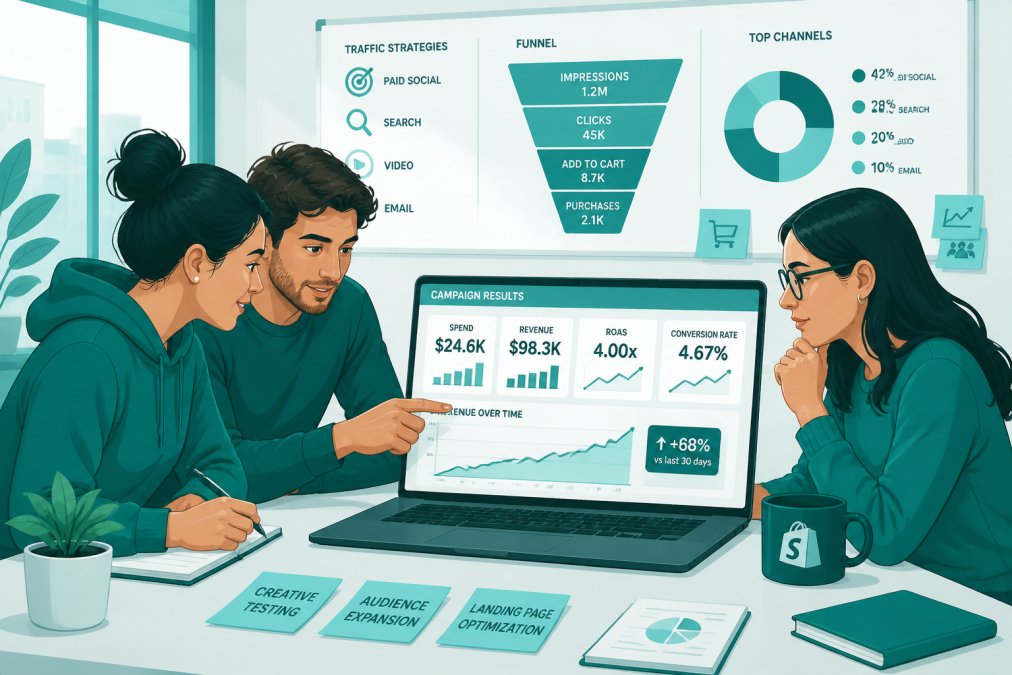
Driving traffic to a Shopify store is straightforward. Driving profitable traffic is the actual challenge. The distinction comes down to customer acquisition cost relative to customer lifetime value.
Paid Advertising and Retargeting
Paid ads remain the fastest way to scale Shopify sales, but the economics only work when targeting is precise and creative is tested systematically. Many DTC brands see ROAS plateau around 2-3x because they're running broad audiences with untested creative.
The approach that consistently improves paid ad performance:
- Segment audiences by intent level. Cold audiences, warm audiences (website visitors), and hot audiences (cart abandoners) require different creative and different bids.
- Test creative systematically. Run multiple ad variations against each other with enough budget to reach statistical significance before declaring a winner.
- Use retargeting to close the loop. Shoppers who visited your product page but didn't buy are your highest-converting retargeting audience.
- Monitor customer acquisition cost against CLV, not just ROAS. A campaign with a 2x ROAS can be profitable if CLV is high enough.
NeuroAds Inc. addresses this exact problem with AI-powered ad optimization and predictive targeting, automating the process of identifying which audiences, bids, and creatives are most likely to convert across Google, Facebook, TikTok, and other channels simultaneously.
SEO, Organic Traffic, and Multichannel Presence
Organic traffic compounds over time in a way paid traffic never does. A well-optimized product or collection page continues to generate Shopify sales months after the initial work is done. According to Shopify's e-commerce SEO guide, optimizing product titles, meta descriptions, and page content for relevant search terms is one of the highest-use long-term investments for store growth.
Core SEO priorities for Shopify stores:
- Optimize collection pages for category-level search terms
- Create supporting blog content that targets informational queries your buyers search before they're ready to purchase
- Build backlinks through PR, influencer partnerships, and product reviews on authoritative sites
- Maintain a consistent multichannel presence across organic search, email, social, and paid ads
Best Shopify Apps for Sales Growth in 2026
The right apps extend what Shopify does natively. The best Shopify apps for sales address specific, documented gaps in your conversion funnel.
Apps worth evaluating by category:
- Abandoned cart recovery: Look for tools that support multi-channel sequences (email + SMS) with behavioral triggers
- Product reviews and UGC: Prioritize apps that display photo reviews and integrate with your email platform for automated review requests
- Upsell and cross-sell: Post-purchase upsell apps that trigger after checkout completion avoid disrupting the purchase flow
- Live chat and chatbot: A well-configured chatbot handles common pre-purchase objections at scale without requiring a support agent for every conversation
- Analytics and reporting: Apps that unify data from Shopify, your ad accounts, and your email platform give you a single view of what's actually driving revenue
Post-Purchase Strategy: Building Customer Lifetime Value
Most Shopify growth strategies stop at the first purchase. That's the most expensive mistake a scaling brand can make. Customer lifetime value is the total revenue a single customer generates across all purchases over their relationship with your brand. Increasing CLV by even a modest amount can make previously unprofitable ad campaigns profitable.
Email Marketing, Referral Programs, and Retention
Email marketing is the highest-margin retention channel available to Shopify brands. A high-performing post-purchase email sequence includes:
- Order confirmation with clear delivery expectations
- Shipping confirmation with tracking link
- Day 3-5: Educational content about the product
- Day 7-10: Review request
- Day 14-21: Cross-sell recommendation based on what they purchased
- Day 30+: Re-engagement offer for customers who haven't returned
Referral programs extend the value of your existing customer base by turning satisfied buyers into acquisition channels. The most effective referral programs offer a meaningful incentive to both the referrer and the new customer.
Using Analytics and KPIs to Drive Data-Driven Decisions
The biggest gap between brands that scale and those that plateau is how they use data. Key performance indicators that should be reviewed weekly:
- Conversion rate by traffic source, not just overall conversion rate
- Average order value, and which products or bundles drive it higher
- Cart abandonment rate, and which pages see the highest exit rate
- Customer acquisition cost by channel
- Repeat purchase rate, the clearest signal of product-market fit and brand loyalty
- Revenue per email sent, the efficiency metric for your email marketing
According to the Shopify Plus blog on e-commerce analytics, brands that review performance data weekly and make incremental adjustments consistently outperform those that optimize in large, infrequent cycles.
The NeuroAds Inc. platform connects these data streams, Shopify, ad accounts, and email, into a unified performance view, so growth teams can identify conversion gaps and act on them without manually reconciling reports from multiple tools.
Frequently Asked Questions
What is the most effective way to increase ecommerce conversion rates on Shopify?
The highest-impact changes are usually in the checkout flow and product pages. Reducing checkout steps, displaying clear trust signals like reviews and secure payment badges, and improving page load speed all reduce friction. Shopify conversion rate optimization also includes mobile-responsive design, since a large share of traffic arrives on phones. Recovering abandoned carts through automated email and chatbot sequences adds another layer without requiring additional ad spend.
How do I attract more people to my Shopify store?
A combination of paid ads and organic traffic works best. Paid advertising on Google, Facebook, and TikTok drives immediate traffic, while search engine optimization builds sustainable organic reach over time. Social media marketing, influencer marketing, and referral programs expand your audience through existing customers. Each channel has a different customer acquisition cost, so tracking key performance indicators per channel helps you allocate budget where it performs best.
How does Shopify abandoned cart recovery work, and how effective is it?
Shopify abandoned cart recovery sends automated follow-up messages, via email, SMS, or chatbot, to shoppers who added items but did not complete checkout. Effective sequences typically send the first message within one hour of abandonment, include the specific products left behind, and may offer a time-limited incentive. Chatbot-based recovery can engage visitors before they leave the store entirely, addressing objections in real time rather than waiting until after they've gone.
Is Shopify still worth it for DTC brands in 2026?
Shopify remains one of the strongest platforms for DTC brands because of its app ecosystem, native payment processing, and multichannel integrations. The platform's fees depend on your plan and payment processor, so factor those into your margin calculations. For brands focused on scaling paid traffic profitably, Shopify's compatibility with third-party analytics, ad platforms, and AI-powered optimization tools makes it a practical foundation for a conversion-first growth strategy.
What are the best Shopify apps for increasing sales?
The most useful apps fall into a few categories: cart recovery and email marketing for retention, review and social proof apps to build trust, upsell and product bundle tools to raise average order value, and analytics apps to track key performance indicators. For brands running paid ads, tools that connect ad account data directly to Shopify purchase events improve targeting accuracy and ROAS. Evaluate apps by their measurable impact on conversion rate rather than feature count.
How do I improve product pages to get more sales on Shopify?
Strong product pages combine clear, benefit-focused copy with high-quality images or video, verified customer reviews, and an unambiguous call to action. Displaying trust signals, secure checkout badges, return policies, and real customer feedback, reduces purchase hesitation. Adding product bundles or volume incentives on the page increases average order value. Mobile optimization is essential: if the page loads slowly or the buy button is hard to tap, mobile shoppers will leave.
Scaling Shopify sales profitably requires fixing conversion gaps before scaling traffic, a principle that most brands reverse at significant cost. NeuroAds Inc. delivers the AI-powered ad optimization, predictive targeting, and integrated Shopify chatbot automation that connects every stage of the customer journey, from first click to repeat purchase. Talk to NeuroAds Inc. and get a clear picture of where your store is losing revenue and exactly what to fix first.
Want AI to improve your ads and conversions?
Tell us where your funnel is leaking revenue and we will tell you what we would change.
Log in to Platform